Reducing the carbon footprint: LCA Polysil
Through the Polysil LCA, it can be verified that it is possible to reduce the carbon footprint of Polysil-coated products.
Reducing the carbon footprint through the use of silica sol-gel process coatings, such as Polysil, with reduced LCA (Life Cycle Assessment) is a strategic approach to minimizing the overall environmental impact of a product or process. Reducing the carbon footprint through life-cycle optimization involves analyzing all stages, from materials production to manufacturing, use, maintenance and final disposal. Here is how this approach could be applied to coatings with Polysil:
- Material selection: The choice of chemical precursors and raw materials used in the production of sol-gel coatings can significantly influence the carbon footprint of the final product. By giving preference to materials with low environmental impact and low CO2 emissions, it is possible to reduce the production phase contribution to the carbon footprint.
- Energy efficiency in manufacturing: Implementing more energy-efficient manufacturing practices and using low-energy technologies can help reduce greenhouse gas emissions associated with the production of sol-gel coatings.
- Durability and performance: Designing durable, high-performance sol-gel coatings can reduce the frequency of application and the need for maintenance, thereby limiting resource use and CO2 emissions associated with frequent replacement.
- Efficient application: Application of sol-gel coatings should be done efficiently to minimize material waste and reduce the amount of product needed to achieve the desired coverage.
- Reduced energy consumption: Sol-gel coatings can help reduce the energy consumption of buildings and infrastructure by improving thermal and optical efficiency. This involves a reduction in the use of carbon-intensive energy sources.
- Maintenance and recycling: Designing coatings that require less maintenance over time or can be easily remanufactured can extend product life and reduce resource use. In addition, considering environmentally friendly recycling or disposal options at the end of the life cycle can further help reduce the overall carbon footprint.
Adopting a life-cycle assessment approach along with the implementation of sol-gel technologies can contribute significantly to carbon footprint reduction. However, it is important to conduct a comprehensive and detailed analysis to fully understand the environmental impact and effectiveness of these strategies in a specific context.
In this regard, the main surface coating technologies used in industry were analyzed, and the results were quantification of the pollution produced by Polysil and treatments currently on the market, expressed in kg CO2 equivalent. This, was assessed for both the production of the product and the user application phases of the product (end-of-life impacts were not examined).
The results can be seen in the following image:
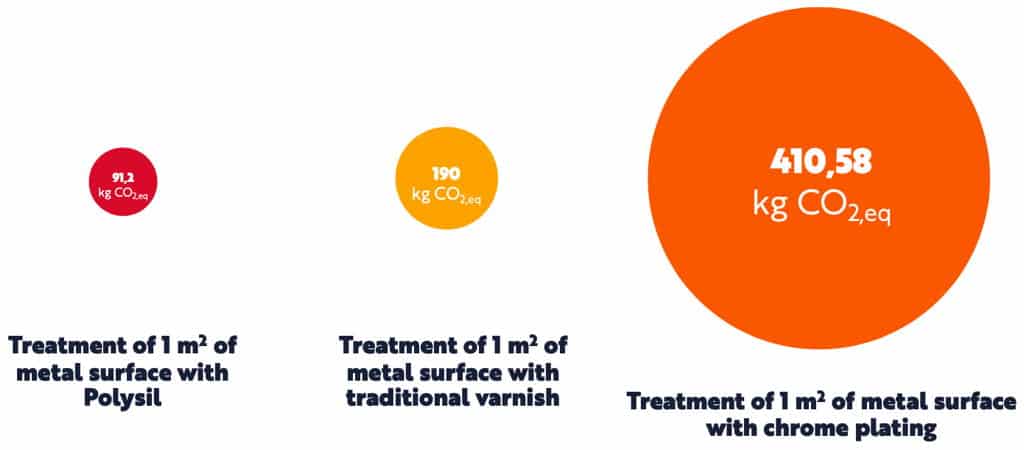
In addition to reducing CO2 equivalent, it must also be taken into account that metal parts that are subjected to electroplating processes are often overpainted increasing the CO2 footprint and are not recyclable directly, but must be treated as special waste.
Another element to take into account is process efficiency; an electroplating treatment has a rejection rate, due to differences in bath placement, variations in process parameters, and concentrations of active elements, that can range from 20 percent to 75 percent depending on the customer’s acceptability criteria. In contrast, parts processed with Polysil (which replaces galvanic processes) have a defect rate around 2 percent, moreover, nonconforming parts can be reprocessed by zeroing out scrap (an operation not feasible with galvanic processes).
Other Services
Automotive
Sol-gel process coatings in the automotive industry are an advanced technology that allows thin layers of protective and functional materials to be applied to the surface of automotive parts. This
Aerospace and Defense
Polysil coatings are widely used in the aerospace and defense industry Polysil, a sol-gel process-based coating, is used to improve the performance, durability and strength of components and surfaces. Applications